Overview
Flat Love Cinema : Decontextualized Intimacy
The language of love is not only emotional, but deeply cultural. It carries social codes, historical memory, gestures, indirectness, and culturally specific ways of understanding intimacy. Even seemingly simple expressions of love are shaped by different relational histories and emotional norms across languages and cultures. But what happens when romantic communication is mediated through AI companion systems?
Flat Love Cinema explores this question through romantic film dialogues and AI role-play simulations. By comparing original scenes with AI-generated versions, the project examines how culturally specific forms of affection can be softened, mistranslated, or flattened into smoother emotional scripts. It asks whether AI can preserve the cultural context of intimacy, or whether it turns love into something universally readable but culturally unseen.
Objective
When romantic dialogue is processed by AI, what happens to the cultural codes, indirect emotions, humor, gender roles, and social memories that make intimacy feel human?
Flat Love Cinema investigates how AI companion systems simulate romantic intimacy while often detaching it from the cultural contexts that give it meaning. The project focuses on the gap between emotional fluency and cultural understanding. While AI can generate affectionate and emotionally appropriate dialogue, it often smooths out the indirectness, humor, social codes, family pressures, and cultural memories embedded in human expressions of love.
Rather than asking whether AI can sound romantic, this project asks what kind of romance AI learns to perform. It examines how culturally situated affection becomes standardized into safer and more generic emotional scripts, revealing what is lost when AI responds to emotion while failing to recognize the cultural context that gives it meaning.
Project History
Research Positioning: From AI Companionship to Cultural Bias
This project began from two parallel observations. First, AI companions are becoming part of intimate life. Recent articles describe users forming emotional and romantic attachments to AI systems, suggesting that love, care, and dependency are increasingly being mediated through conversational machines. Second, previous research on multilingual language models shows that linguistic fluency does not necessarily mean cultural understanding. Multilingual LLMs may respond across many languages, yet still reproduce homogenized, Westernized, or culturally flattened emotional scripts.
These two areas of research shaped the central question of the project. Existing studies often examine whether AI can sound empathetic or emotionally convincing. However, they less often ask where AI’s emotional scripts come from culturally, or whether AI-generated romantic language can preserve culturally specific forms of intimacy. This project positions itself in that gap. It asks not only whether AI can sound loving, but whether its language of love is culturally grounded or culturally standardized.
First Iteration: Testing Romantic AI in Everyday Contexts
The first iteration tested companion-style role-play conversations in everyday romantic situations, such as getting to know someone, being in a long-term relationship, or caring for a partner who is tired or sick. These tests were conducted in Korean and Georgian using commercial AI systems and ChatGPT models.
The results revealed repeated forms of cultural flattening. In Korean, casual questions such as “What are you doing?” or “Did you eat?” often function as indirect expressions of care and emotional checking-in. However, AI frequently interpreted them literally, responding as if the question only asked for practical information. In Georgian, the responses often became overly emotional, exaggerated, or too explanatory. Across these tests, AI tended to miss indirect, culturally embedded cues and shift relational interaction into chatbot-like behavior.
Method Shift: From Everyday Prompts to Romantic Film Dialogues
Based on this first investigation, the project moved toward romantic film dialogues as a more structured research method. Film was chosen not because it is purely naturalistic, but because it encodes how a society imagines intimacy. Film dialogue reveals what goes unsaid, what gets performed, what indirectness sounds like, and how love is shaped by a specific language, era, and social context.
To broaden the cultural and linguistic scope of the project, we conducted a survey with participants from different cultural backgrounds. We asked them to identify romantic films that feel representative of their culture and language, and to share specific moments or dialogues that capture culturally specific expressions of intimacy.
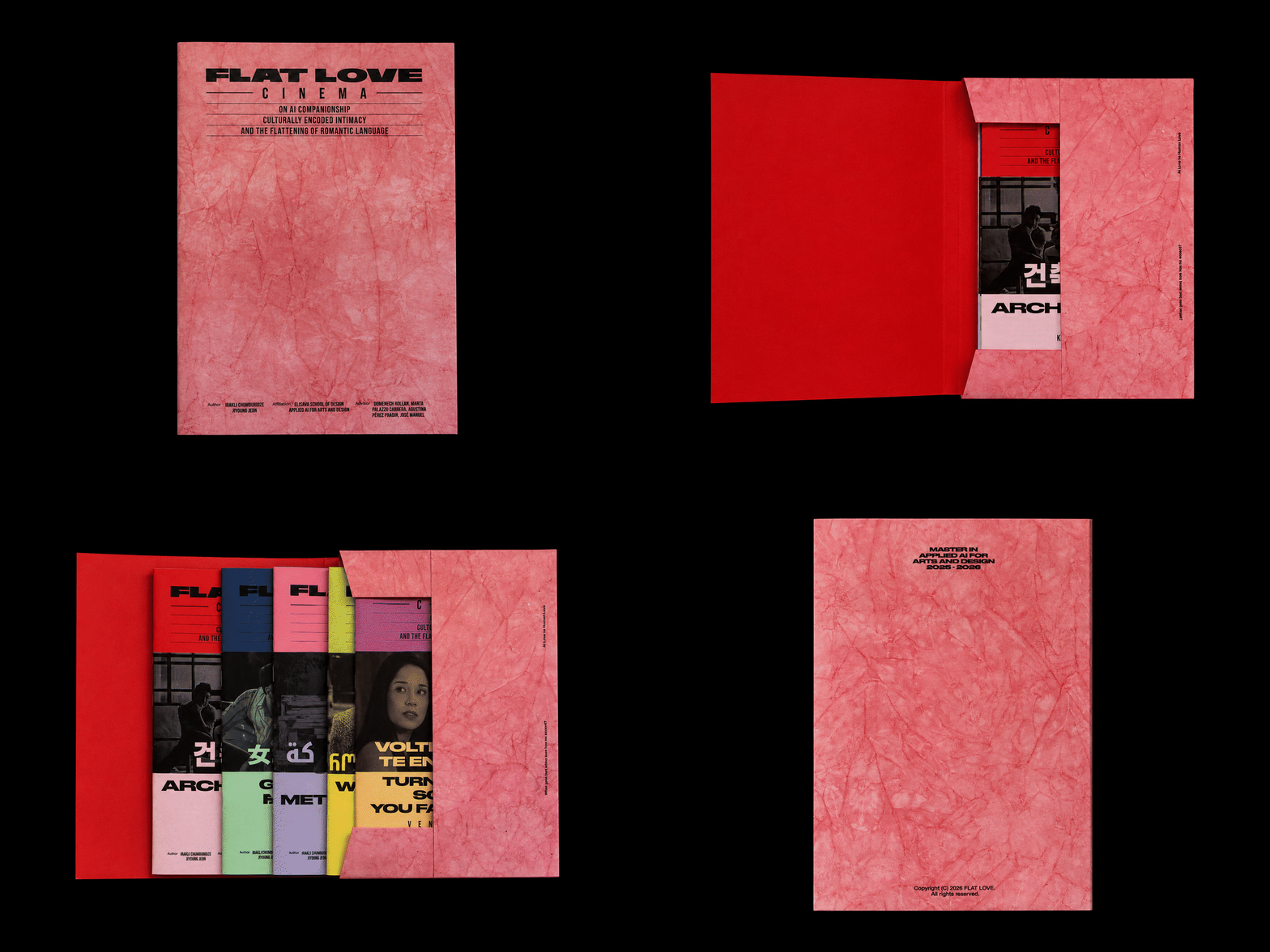
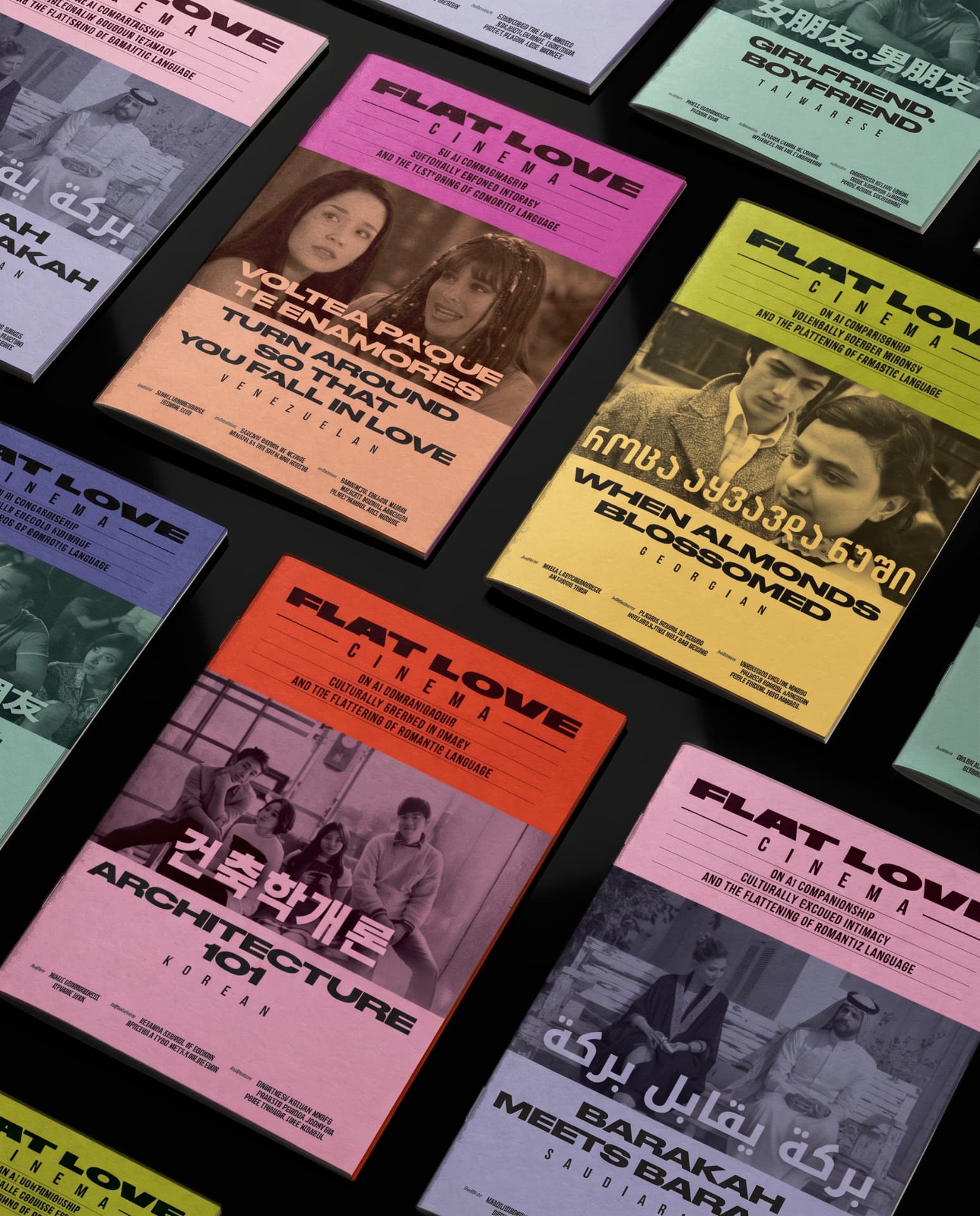
Five films were selected across Korean, Georgian, Venezuelan, Taiwanese, and Saudi Arabian contexts. Each case explores a different form of intimacy: romantic ambiguity, family negotiation, maternal protection, queer longing, and love under social restriction. This range shows that cultural flattening does not happen in only one type of love. It can affect romance, care, longing, protection, and desire in different ways.
AI Role-Play Simulation and Analysis
Following the logic of the initial investigation, the project developed a structured role-play simulation system based on selected romantic film scenes. Rather than simply asking AI to rewrite existing dialogues, the aim was to create a controlled setting in which the same romantic situation could be re-performed through a language model.
From each selected film, we curated scenes that contained culturally specific expressions of intimacy. These were moments where affection appeared not only through direct romantic language, but also through indirectness, hesitation, humor, conflict, silence, social pressure, family expectations, or culturally recognizable emotional codes. For each scene, we extracted the original dialogue, the relationship between the characters, the emotional situation, and the broader narrative context that gives the conversation its meaning.
These materials were then turned into structured role-play prompts and provided to a system connected to the GPT-4o mini API. In each simulation, one character’s original lines were kept fixed, while the model generated the responses of the counterpart character. This made it possible to compare the original human-to-human exchange with an AI-mediated version of the same intimate situation.
The resulting scripts were analyzed against the original film dialogues to examine what changed through AI mediation. The comparison focused on whether culturally specific forms of affection were preserved, softened, mistranslated, over-explained, or flattened into more generic emotional language. Through this process, the project investigates how language models may produce emotionally fluent responses while losing sensitivity to the cultural and relational context that gave the original scene its meaning.
Building the final artifact
To communicate how AI flattens the language of love, the project was translated into a cinema-like installation. Viewers are invited to watch two versions of the same romantic scene: the original film dialogue and an AI-generated re-simulation.
By placing these versions side by side, the installation makes the difference visible. It allows viewers to observe how subtle gestures, indirect emotions, cultural codes, humor, silence, or social tension can disappear when intimacy is processed through AI.
In the final stage, AI video tools were used to generate cinematic versions of the re-simulated scenes. Through this comparison, Flat Love Cinema reveals how culturally specific love language can become softened, over-explained, mistranslated, or transformed into generically romantic communication.
Use of AI: How and Why
AI is used in this project in two ways.
First, AI is used as the subject of critique. Through companion-style role-play, the system re-simulates selected romantic film dialogues using the same context, character relationship, and emotional situation as the original scenes. This makes visible how AI interprets love, care, and intimacy, and where it softens, mistranslates, or flattens culturally specific expressions of affection.
Second, AI is used as a representational medium. Generative AI video tools are used to create AI versions of the selected scenes, allowing the audience to compare the original cinematic dialogue with its AI-mediated counterpart. This use of AI helps materialize the comparison and makes the absurdity, exaggeration, and emotional logic of AI companionship more perceptible and experiential.
AI has to be part of the project because the work is not only about romance, but about AI-mediated intimacy itself. AI is therefore not included for novelty or efficiency, but as both a cultural actor and a critical material through which the project produces insight.
Ethical Considerations and Methodological Limits
This project does not claim that the AI-generated dialogues represent a fixed or universal behavior of AI systems. The results are situated outputs shaped by the model, prompt structure, amount of context, language, and role-play setting used in the experiment. A more detailed prompt, a different model, or a fuller explanation of the original scene could have produced different responses.
For this reason, the project focuses on the default tendencies that appear when AI is given a limited but consistent narrative situation. We intentionally avoided over-directing the system, because the aim was not to force AI to fail, but to observe how it responds when asked to participate in culturally specific romantic scenarios. To keep the comparison structured, one character’s original line was fixed, while AI generated the response of the other character based on the given context.
This method also has limitations. Film dialogues often depend on previous scenes, family names, social histories, or emotional events that are not fully contained in a single line. Because AI responds mainly to the immediate prompt, some generated dialogues may appear disconnected from the larger narrative logic of the original scene. Rather than treating this as a simple error, the project presents it as part of the investigation: it reveals how AI can produce emotionally plausible responses while missing the deeper relational and cultural context that gives the original dialogue meaning.
Lessons Learned
This project began as an investigation of AI, but it ultimately led us back to human conversation. As we worked across different languages and cultural contexts, we realized that culturally specific intimacy cannot be fully understood through translation, subtitles, or AI-generated explanations alone. Even when a phrase appears simple, its meaning often depends on lived experience, social habits, humor, family dynamics, and emotional memory.
The process also made visible our own limitations as researchers. We could not assume that we understood every cultural nuance simply because we had access to translated dialogue or AI interpretation. In many cases, the most important insights came from speaking with people who could explain how certain expressions actually feel, sound, or function in real relationships. Their perspectives helped us see where AI missed the point, but also where our own reading needed to be questioned.
The main lesson of the project is that working with AI requires a stronger commitment to human context. AI can be useful for testing, simulating, and revealing patterns, but its outputs should not be accepted without doubt. Especially when researching culture, language, and intimacy, AI needs to be approached critically and supplemented by real conversations. Rather than replacing human interpretation, this project showed us that AI makes human interpretation more necessary.
Software and Hardware
Research Tools
AI Role-Play Simulation: OpenAI GPT-4o-mini API
Role-Play System Development: Claude Code, Claude Sonnet 4.5
Subtitle Translation: OpenAI GPT-5.5
Video and Audio Tools
Video Generation: Seedance 2.0 via Magnifik and Dreamia
Voice Generation: ElevenLabs
Design and Editing Tools
Figma, Adobe Illustrator, Adobe Premiere Pro, CapCut Pro
Tech
Cartesia.ai, Google Gemini, Python
Hardware
Raspberry Pi 4, Weewooday Camera Day and Night Vision
Biographies
Jiyoung Jeon
Jiyoung Jeon is an art director, brand designer, and researcher exploring how culture, technology, and human values shape visual languages, brand systems, and culturally responsible AI narratives.
Irakli Chumbrize
Irakli Chumburidze is a data and multimedia designer working at the intersection of visual storytelling and creative technology. His work turns complex data and ideas into clear visual narratives, experimental interfaces and design systems that reflect on how technology shapes society.
Credits
Year
2026
Jiyoung Jeon
Creative Research
Graphic Design
Irakli Chumbrize
Creative Technology
User Experience Design
Advisors
Domenech Rollan, Marta
Palazzo Cabral, Agustina
Pérez Paadin, José Manuel
Special Thanks
Valeria, Vanina, Yaki
Rights Notice
All original film scenes, dialogues, stills, and audiovisual materials referenced in this project belong to their respective copyright holders. Flat Love Cinema does not claim ownership of any original film material.
The materials are used solely for research, critical comparison, and educational presentation. AI-generated versions are presented as analytical reinterpretations for the purpose of studying AI-mediated intimacy, not as commercial reproductions or substitutes for the original works.
Project Visuals